Statement
My work consists of tearing fragments of meaning from my life.
I try to recreate states and affects through different mediums.
I look for forms and accidents that resonate with my own experience.
For me, drawing and painting are not tools for representation, but for dislocating, colliding, and breaking down barriers.
In my work on interior and exterior spaces in painting,
or the confrontation of subjects and supports in drawing, there is always an opposition, a contamination at play.
The idea is to eventually accept discomfort and the lack of control, so that by letting oneself slide into the image, one finds something other than what was expected.
Biography
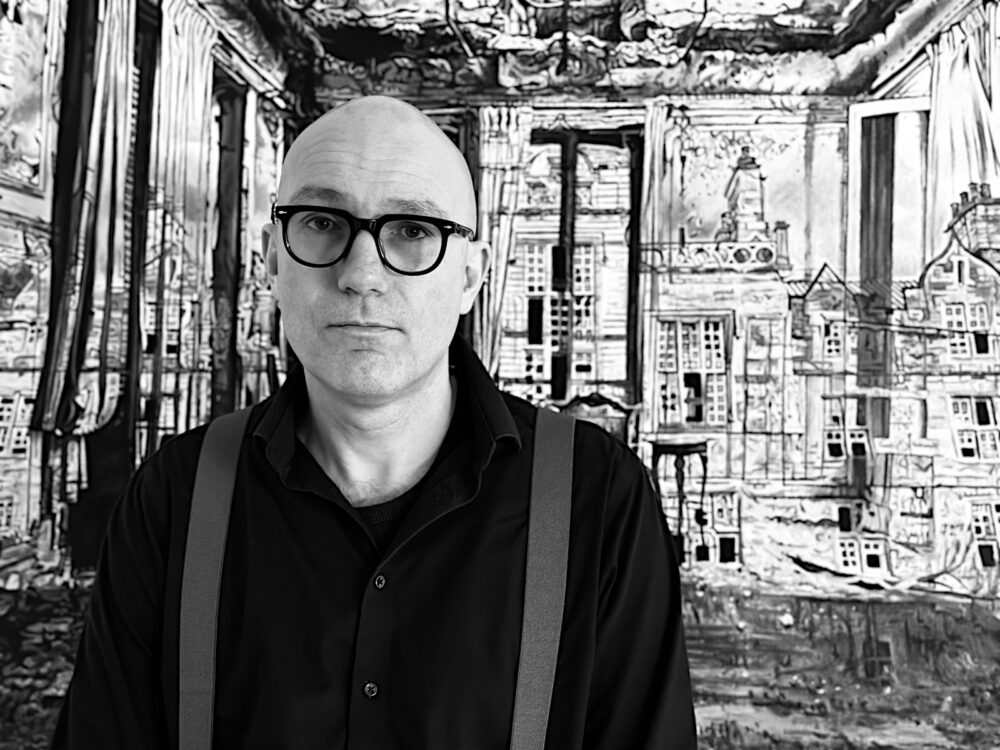
Photo credit : Philippe Aimar
Franck Saïssi (born 1975, Grenoble) lives and works in Nice.
His work explores disappearing architectures, the invasion of industrial structures, and the fragility of existence.
Trained at the École Émile Cohl (Lyon), the Beaux-Arts in Carrara (Italy), and then at the Ateliers des Beaux-Arts in Paris.
He pursues a rigorous pictorial research focused on the collapse of spaces, whether they belong to the private sphere, public territories, or collective memory.
From his art studies, he retains both an exacting and humble approach to painting, as well as a certain spirit of revolt.
Painting and drawing are, for him, means to disturb, to question, and to deepen a form of knowledge of self and the world.
Installé à Nice depuis la fin des années 1990, il dessine sur des livres trouvés au détour des rues, incomplets ou dégradés, et sur des cartes marines anciennes. Dans son atelier, il peint à l’huile sur de grands formats, où il mêle architecture, perspectives et matières, dans des séries en rapport avec la mémoire, la perte de repères.
Selected exhibitions
• Lost, Maison Abandonnée [Villa Cameline], Nice (2021)
• Perfect Day : Drug and Art, WhiteBox, New York (2021–2022)
• La Vie est un Film, Le 109, Nice (2019)
• Le Palais Idéal du Facteur Cheval, Musée du Facteur Cheval, Hauterives (2016)
• ST-ART Strasbourg (2023)
• Paréidolie, Marseille (2025) — Guest Artist
For several years, Hélène Fincker, director of the Maison Abandonnée [Villa Cameline], has championed his work with rare loyalty.